 HCPSS
HCPSSBuilding a Data-Driven Support System That Works for All
April 21st, 2026
Staff in the Howard County Public School System’s (HCPSS) Division of Academics and Department of Special Education (DSE) are thoughtfully and deliberately beginning to implement the targets identified in the five-year DSE Strategic Plan as they strive to influence student and staff outcomes.
A major lift of that work focuses on building Multi-Tiered Systems of Support (MTSS), and preparing staff to connect all students with supports and resources equitably to accelerate student learning and foster a safe and supportive learning environment.
“I am really passionate about implementing MTSS in Howard County,” said Kate Cramer, School Psychology Instructional Facilitator. “It provides us with a framework for making sure all of the resources and supports in our county are equitably distributed to all of our kids, all of our schools and all of our families in a systematic, data-fueled way.”
MTSS is an organizational framework that features a layered system of support for all students, including those receiving special education services. The tiers of support apply to both a student’s learning and behavior at the same time, rather than addressing them separately.
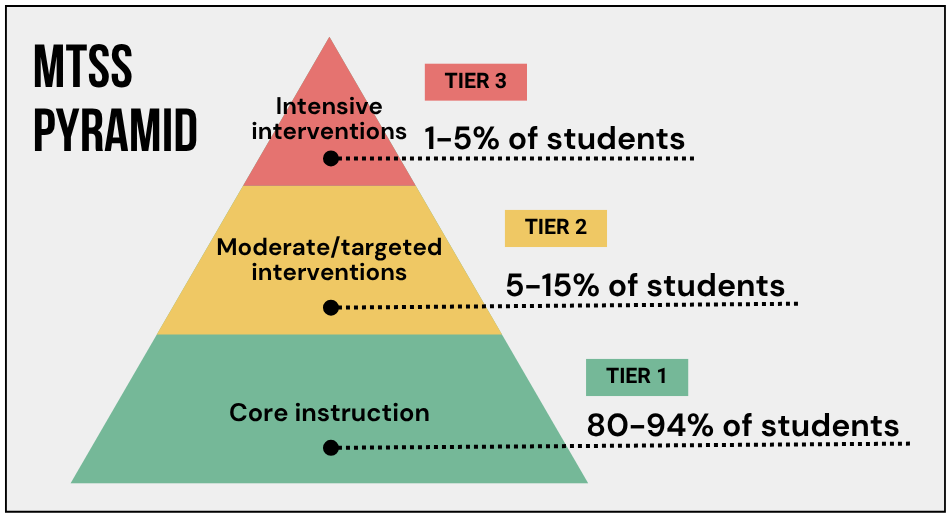
MTSS includes three tiers: Tier 1 is the high-quality core instruction and social-emotional supports all students receive; Tier 2 is the supplemental, targeted supports some students receive; and Tier 3 is the intensive interventions few students will need. But what does this look like in the classroom?
MTSS Tier 1 Supports
“High-quality Tier 1 instruction is for all students. It’s about educators differentiating their instruction to meet student needs. There may be a student who learns better from visuals, another who needs additional practice opportunities and another who may need some extra nudges and reminders,” said Cramer. “We have wonderful teachers naturally doing these things to meet the needs of their kids and we are committed to continuing to strengthen this area.”
“Tier 1 behavioral supports form the foundation of our MTSS, representing the universal practices and structures provided to all students,” added Rebecca Godwin, Behavioral Intervention Facilitator. “At this level, students benefit from schoolwide Positive Behavioral Interventions and Supports, explicit social skills instruction, and clear, consistent routines and behavioral expectations, all implemented within a framework of supportive relationships and restorative practices.”
MTSS Tier 2 Supports
For some students, Tier 2 supports may be provided in addition to, but never in place of, Tier 1. Tier 2 provides targeted supports for students who need additional practice, clarity or reinforcement in specific skills areas, which could look like small-group reteach sessions or behavior skill groups—often occurring in the classroom.
“Tier 2 targeted supports could include additional coaching and feedback through stations, adult feedback or peer feedback. It’s more short-term. It could be delivered by the classroom teacher or an instructional paraeducator supporting that classroom,” said Bianca Roberts, Special Education Resource Teacher. “All of these efforts involve regular progress monitoring to see if change is happening and to make data-informed decisions about next steps.”
Progress-monitoring is a key component of MTSS and at the Tier 2 level, it will help staff to determine if students are improving, need continued support or require more intensive intervention.
“This is a timely and responsive process for all of our students, which includes students with IEPs or 504 plans. While these students have a plan to support their instruction in specified areas, this process ensures that any student has what they need to be successful throughout their entire day,” explained Cramer. “For example, the data may show a student needs targeted intervention to meet grade level standards in a given content area. If that student does not respond to the targeted intervention, that may indicate a more intensive intervention is needed.”
MTSS Tier 3 Supports
If Tier 2 supports are not moving the needle for certain students, they would transition to receiving Tier 3 supports, which are the most intensive, individualized supports based on significant or persistent needs. These supports are based on a deep understanding of a student’s unique needs and may include personalized plans to help with behavior, learning or social-emotional development.
“Providing students with Tier 3 intensive academic supports could look like a student meeting one-on-one with a reading or math specialist,” said Cramer. “Then, on the behavioral side of things, it could be a student meeting with a counselor or psychologist to work on regulating emotions.”
“The intensive supports are needed when we discover there’s a wider gap to address, meaning the foundational skills needed for academic success are missing,” Roberts added. “As an example, a student’s peers may be reading in full sentences and paragraphs, but the student is reading at the one- or two-word level so we intentionally target that area through more intensified opportunities for intervention and practice.”
MTSS Platform
To implement the MTSS vision, a cross-divisional team is developing a platform in Synergy, HCPSS’ student information system, providing one system for documenting Tier 2 and Tier 3 supports, tracking student response and ensuring decisions are consistent across schools.
The MTSS dashboard will allow staff to view and input data, which will enhance the real-time ability for staff to see who is on track, who is ready to advance and who is at risk and may need more support. Student support teams will be monitoring the behavioral data to determine if additional interventions are needed.
“By using the MTSS platform in Synergy, we are aligning our structures across content areas and across schools,” said Yvonne Cox, Language Arts Curriculum Coordinator. “When we align our structures, we have common language and common data collection practices so there is less confusion for the adults, and when there’s less confusion for the adults, there is less confusion for our students, and we can collaborate effectively to support all of our learners.”
Once the platform is operational, parents will be able to access student plans and view real-time data updates.
“From a special education lens, MTSS shifts us to being more proactive, ensuring more needs are met early through shared ownership and strong instruction,” said Melissa Brunson, Executive Director of Special Education. “It also strengthens communication with families by creating clearer, more consistent pathways for a deeper understanding of student progress and support.”